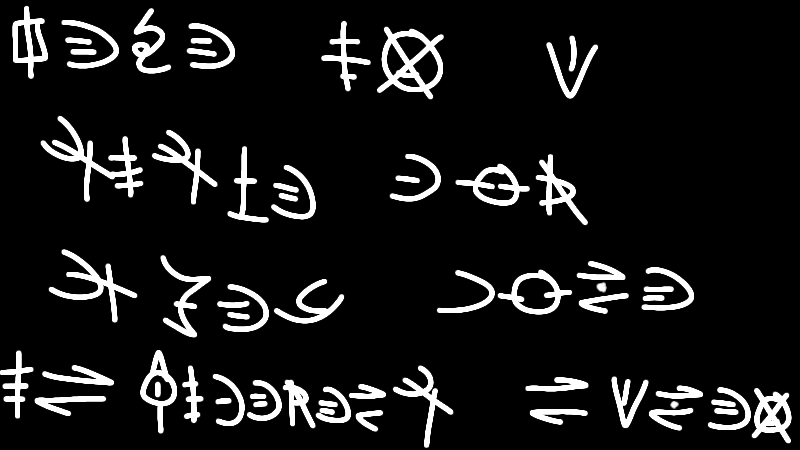
The night pressed heavily against the house, thick with silence and the lingering weight of what they had done. Jed and Amanda moved carefully through the hallway, their steps slow and deliberate as they carried the body between them. Every creak of the floor sounded louder than it should have, as if the house itself disapproved of what they were bringing inside.

They had grown efficient together — no words needed, no hesitation. Their movements mirrored one another, practiced and instinctive, as though they shared the same rhythm of thought. Whatever fear had once existed between them had been replaced by something colder: understanding.

Zeke’s door opened without a sound.

They slipped inside, lowering the anomaly onto the bed. The sheets shifted under the weight, the figure lying unnaturally still beneath the dim light spilling in from the corridor. Amanda stood there for a moment longer than necessary, staring. Earlier, the thing had terrified her — its presence wrong in a way she couldn’t explain — but after touching it, after feeling its strange stillness, the fear had dulled. Not gone. Just… distant. Like a memory that no longer belonged to her.

Jed gave a small nod and left without a word.

Amanda exhaled quietly. The room felt suffocating now that the task was done.

*I should leave before Zeke starts asking questions.*

She turned toward the door, already reaching for the handle.

The door slammed shut before she could touch it.

Amanda froze.

Zeke stood there, leaning casually against the door, smiling — not warmly, but with a calm that made her stomach tighten. She avoided his eyes, focusing instead on the floor, on anything that wasn’t him. Still, she could feel his attention resting on her, patient and deliberate.

“I’d love it if you sat down,”Zeke said softly. “Be comfortable.”

The words sounded polite, but something beneath them wasn’t.

Amanda moved slowly, perching on the edge of his study desk. Behind her, she heard the quiet click of the lock turning. The sound echoed louder than it should have.

Her pulse quickened.

*What is he doing? He thinks he can keep me here?*

“Amanda,” Zeke continued, walking closer, his tone almost conversational. “I just remembered something. I used to know this lovely cat. It was new to the place back then… and so it was a very curious creature.”

He stopped a few steps away.

“The problem with curiosity,” he said, “is that you end up where you shouldn’t be.”

Amanda’s fingers tightened against the edge of the desk.

“The cat ended up in the wrong place at the wrong time.”

Zeke reached into his pocket and pulled out a knife. The metal caught the faint light, flashing once before settling in his hand. He didn’t raise it. He didn’t need to.

"I’m sure you’ve noticed,” he continued calmly, “what happens to people who find themselves in the

wrong places. Wrong times.”

Amanda’s breath grew shallow. She still refused to look directly at him.

“I wouldn’t want that for you,” Zeke added, his voice softening slightly. “We’re related, after all. And you helped me with… this troublesome kid.”

The knife disappeared back into his pocket as casually as it had appeared. He tossed a set of keys toward her. Amanda tried to catch them, but they slipped through her fingers and clattered onto the floor.

“You can’t judge what you don’t understand, Amanda.”

He stepped aside, unlocking the door.

“Try not reporting us,” he said with a faint smile. “Prison isn’t a kind place.”

Amanda didn’t respond. She grabbed the keys, opened the door, and left quickly, the air outside feeling colder but easier to breathe. Only when the door closed behind her did she realize her hands were shaking.

Inside the room, Zeke’s smile faded as he looked back at the body on the bed.

The house fell silent again.

Zeke let out a long breath once the house had fallen quiet again.

“Can’t believe that just happened,” he muttered to himself, running a hand through his hair. “I’ve got a partner now… huh. Maybe I should sleep on it.”

His gaze drifted toward the bed.

The anomaly lay where they had left it, still and unnervingly composed in the dim light. For a moment, he simply stared at it, head tilted slightly, studying it the way someone might study a puzzle piece that didn’t quite fit.

“Looking almost peaceful,” he murmured, squinting as if trying to see beyond the surface. The faintest smirk touched his lips — not desire, not affection — just the strange humor he found in things that disturbed other people.

He shook his head lightly, as if dismissing a thought before it could fully form.

“Yeah… I definitely need sleep.”

He walked to his study table and switched off the lights. The room plunged into darkness, broken only by thin silver lines of moonlight sneaking through the curtains. Instead of the bed, he dropped into his chair, leaning back, arms folded loosely. He slept there — not comfortably, but deliberately — as though keeping distance from what rested only a few feet away.

Morning

Amanda had barely slept.

Her body had surrendered to exhaustion at some point, but her mind hadn’t. It replayed the night over and over — the weight of the body, the silence, the way Zeke smiled while locking the door.

She stood now outside his room, early light stretching pale gold across the hallway floor. Dust floated lazily in the air, innocent in contrast to the heaviness she felt.

*I want to believe it was just shock… but I can’t ignore what I saw.*

She raised her hand and knocked.

Once.

Twice.

A third time.

Inside, movement. A chair scraping softly against the floor.

The door opened just enough for Zeke to stand in the frame. His hair was messy, eyes slightly unfocused from sleep, expression unreadable. He blocked most of the view inside.

Amanda leaned subtly, trying to peek past him.

He shifted — casually — and pulled the door further closed behind him.

Without a word.

She didn’t push. She just stared at him for a moment longer before stepping back.

Downstairs, time felt strange. It moved too fast and too slow at the same time. Amanda sat on the couch, her phone in her hands, though she wasn’t really looking at it. Her thoughts were louder than anything on the screen.

Footsteps.

Zeke descended the stairs like someone half-awake, movements steady but distant. His face carried that same neutral calm — not tired, not alert. Just… there.

He passed her without comment and headed toward the kitchen.

*He didn’t even shower,* Amanda noted. *Good. That means I still have time.*

“Zeke,” she said casually, as though nothing unusual had happened the night before. “Lucien left food in the kitchen. The one on the left is yours. The right one’s mine — I already ate a bit.”

He gave a slight nod, acknowledging her without fully looking at her.

Amanda watched him begin to eat.

*Now’s my chance.*

She stood up slowly, careful not to draw attention. Her steps were silent against the floor as she slipped into the corridor. The house felt different in daylight — less ominous, but no less secretive.

She reached his door and gripped the handle gently.

Locked.

Her jaw tightened.

*When did he even lock it? He wasn’t locking it before. That proves something. He’s hiding more than just that thing.*

She returned to the kitchen, where Zeke was rinsing his plate in the sink. Water ran steadily, filling the silence between them.

Amanda stepped beside him, pretending to scroll through her phone before looking up.

“I know what I saw yesterday,” she said lightly, though her eyes were sharp. A small smile tugged at her lips — not playful, but challenging.

He didn’t look at her.

“And you said I’m involved,” she continued. “So you owe me more than silence. I want to see it again. And whatever else you’re hiding in that room.”

She paused, studying his profile.

“Basically, I want to know everything.”

The water kept running.

Zeke finally turned his head toward her. His expression didn’t shift much — just a faint narrowing of the eyes, as if calculating.

Inside his silence, something moved — a thought she couldn’t access.

*She’s curious,* he considered quietly. *Curiosity can be shaped. Used. Tested.*

“Zeke,” Amanda snapped her fingers lightly near his face. “Are you even listening?”

He blinked once, as if returning from somewhere far away.

“Oh. Yeah. What’s up, Amanda?”

Her irritation flickered.

He dried his hands calmly.

“I’ll show you later,” he said, voice even.

That was it.

No explanation. No promise. Just enough to keep her waiting.

He walked past her and toward the door, leaving the house without another word.

Amanda stood there, staring after him.

*What is wrong with him?*

Frustration simmered under her skin, but beneath it was something stronger — obsession.

*Fine. If he won’t let me in… I’ll find another way.*

The house felt larger now.

And quieter.

And full of locked doors.

She was still crying when she asked it.

“Why help me?”

Her voice wasn’t angry. Just tired. Like she expected the answer to disappoint her.

Lethe didn’t answer immediately.

He was still holding her hand — not tightly, not gently — just enough so she wouldn’t feel alone in the space between seconds.

He looked at her for a long moment, studying her face the way he studies broken things.

“You really wanna know?” he asked quietly.

She nodded.

He exhaled through his nose.

“I don’t help everyone.”

A small pause.

“Just the ones who look like they’re about to disappear.”

Her crying slowed.

He looked away from her then, staring at nothing in particular.

“When you’re in that place,” he continued, “where you’re calling out and nobody shows up… it does something to you.”

His jaw tightened slightly, but his tone stayed even.

“You start thinking maybe you’re not worth showing up for.”

Silence stretched between them.

“So yeah,” he shrugged faintly. “If I see someone standing there alone like that, I help.”

Another pause.

“Not because I’m good.”

His eyes flickered back to hers.

“Because I know what it costs when no one does.”

She squeezed his hand without realizing it.

“Thank you,” she whispered.

For a brief second — barely noticeable — Lethe felt something anchor inside his chest. Like gravity returned. Like he wasn’t fading at the edges.

He gave her a small nod.

“Don’t thank me,” he said.


### A Week Ago


Lethe Vestige woke up gasping.

His heart pounded violently against his ribs. His clothes clung to his skin, soaked. He pushed himself up from the ground and realized he was lying beside a grave.

The cemetery stretched endlessly around him — rows of

tilted headstones, some cracked, some sunken into the earth like they were slowly being swallowed. The sky above was grey, but not storming. The ground beneath him was dry.

Yet he was drenched.

He stared at his sleeves.

Was it sweat?

Rain?

There were no puddles. No clouds heavy enough to explain it.

His breath came unevenly as fragments of memory surfaced — flashes of voices, a house, a laugh, running — and then vanished just as quickly, dissolving before he could hold onto them.

"Wait—" he muttered to himself, clutching at his head as if he could physically grab the thoughts before they slipped away.

Nothing stayed.

The cemetery felt wrong. Not haunted. Not evil.

Just… misplaced.

Like he didn’t belong in the same layer of reality as it.

He stood, brushing dirt from his clothes. The wind moved softly through the trees, but it made no sound. Even the world seemed distant, like it was happening behind glass.

He walked.

It took longer than it should have to find the exit. The gates appeared once, then weren’t there. Paths curved back into themselves. Headstones seemed rearranged when he looked away.

Finally, he stepped beyond the iron gates.

The city greeted him.

Except it wasn’t the city he remembered.

Buildings stood taller. Colors were different. Streets had been widened. New signs hung where old ones should have been. The air felt thicker, heavier — like time itself had weight here.

He looked up at the sky.

Afternoon.

That made no sense.

It had been morning.

It had been morning.

“It was ten minutes…” he whispered.

But the shadows said otherwise.

Panic began to coil in his chest again.

He walked through the streets, scanning faces, trying to anchor himself in something familiar. Some people brushed past him without reacting at all. One man walked straight through his shoulder as if Lethe wasn’t there.

Lethe staggered, turning sharply.

“Hey—”

The man didn’t even flinch.

A group of teenagers laughed nearby. Lethe reached out, grabbing one by the sleeve.

His fingers felt fabric.

But the boy didn’t turn.

Didn’t react.

Didn’t feel him.

“What the hell—?” Lethe muttered.

His hand was there.

He could see it.

He could feel them.

So why—

He stopped at a crosswalk where a girl stood waiting for the light to change.

“Hey, hey,” he said quickly. “Can you tell me what time it is? And… where am I? I’m lost.”

She turned.

She looked directly at him.

“It’s 3:35 PM,” she said casually. “And this is Eastern Ravenport.”

Eastern Ravenport.

He froze.

Ravenport hadn’t looked like this.

Not like this.

“Thanks…” he said weakly.

She walked away.

He stood there long after the light turned green.

*How can she see me but others can’t?*

*How can I touch some people but not exist to them?*

*What decides whether I’m real?*

The questions piled up, suffocating him.

Eventually, his feet carried him home — or what he hoped was home.

The gate stood there exactly as it always had. Slight rust on the hinges. The familiar dent near the bottom from when he’d kicked it years ago.

He pushed it open slowly.

He remembered jumping it instead of opening it. Remembered laughing about it.

The house looked unchanged.

The door wasn’t locked.

Of course it wasn’t.

He used to be the one who locked it, because his mom always forgot.

He stepped inside.

The air smelled the same.

Furniture in the same places.

Walls the same faded shade.

Until his eyes drifted to the picture frames.

He stopped breathing.

His mother stood alone in every single one.

Birthdays.

Holidays.

Old family photos.

She was there.

But he wasn’t.

No space where he should have been. No awkward cropping. No empty gap.

Just… her.

As if he had never stood beside her.

His chest tightened, but the emotion didn’t arrive properly. It was like something was blocking it — like grief was trying to load but failing.

He walked down the hallway quickly.

To his room.

He stopped.

There was no door.

Where his room should have been was just an unbroken stretch of wall.

Smooth.

Uninterrupted.

No outline. No trace.

He touched it.

Cold.

Solid.

Wrong.

He stepped back slowly, staring at the place where his entire existence had once been stored — clothes, games, books, memories.

Gone.

Not removed.

Erased.

He left the house without slamming the door. Without crying.

Crushed.

Not loudly.

Not dramatically.

Just… hollow.

The world continued moving around him as if nothing had changed.

Because to it —

nothing had.

And that was when Lethe Vestige understood something far worse than death.

He hadn’t died.

He had been forgotten.

Present Day

Zeke was walking with no real destination, just distance.

Distance from Amanda.
Distance from the thing in his room.
Distance from questions.


Across the street, near the park benches, he noticed a girl. A boy was talking to her — too close, too persistent. She kept stepping away, shoulders slightly turned, clearly uninterested. The boy didn’t get it.

Zeke slowed his pace.

She wasn’t dramatic about it. No yelling. No scene. Just… retreating. Protecting her quiet.

Then she left.

Interesting.

Not because she was pretty — though she was — but because she looked like someone who valued peace. And Zeke understood that kind of escape.

--------------

Zeke walked until the city noise thinned out behind him.

Concrete turned into sand.
Engines turned into wind.

The beach opened wide before him — endless and breathing.

The ocean stretched like a living thing, its surface shifting under the pale afternoon light. Waves rolled in steady rhythm, not violent, not weak — just constant. Each one folding into the shore with a soft crash, then retreating with a dragging whisper as the water pulled the sand back with it.

The breeze moved freely, carrying the sharp scent of salt and something clean. It brushed against his face, slipped through his hair, tugged lightly at his shirt like it was testing whether he planned to stay.

Seagulls circled lazily overhead, their distant cries thin and echoing. Not loud enough to disturb the peace — just enough to remind you the world was alive.

The sun wasn’t harsh. It rested over the water in a soft glow, turning the surface silver in places, blue in others. Light scattered across the waves like broken glass.

For once, nothing demanded anything.

No voices.
No tension.
No locked doors.


Just space.

It felt almost unnatural.

Zeke stood there for a moment, letting the sound of the water fill the gaps in his head.

And then he saw her.

She stood a few steps away near the shoreline, phone raised slightly, capturing the horizon. The wind moved her hair gently across her face, but she didn’t seem bothered by it. She wasn’t posing for the picture.

She was preserving the quiet.

There was something about the way she looked at the sea — not excited, not dramatic — just… absorbing it.

Like this was her place.

Like this was where she came when the world got too loud.

Zeke recognized that.

The park hadn’t given her peace.
So she found another place.

He stepped closer, sand shifting softly under his shoes.

“Heyy🎅🚬💨,” he said.

She blinked slightly, like she had just returned from somewhere deep inside her own thoughts.

“Hey,” she answered softly.

Her voice didn’t fight the wind. It blended with it.

“How are ya,” Zeke asked, glancing at the horizon before looking back at her.

The waves kept rolling behind them.
The breeze moved between them.
For a moment, it felt like the ocean was listening.

“I’m fine… and you,” she said.

There was that pause again.
Like words had to travel a little further to reach her mouth.

Zeke smirked faintly.

“I feel like I’m hung on a tree by my balls 🍒.”

She froze for half a second.

Then a quiet laugh slipped out — quick, almost accidental. She turned her face slightly toward the water as if hiding it.

The wind carried her small laugh away before it could fully exist.

And the sea kept breathing.


### In Western Ravenport City

Night had settled fully over the city.

Streetlights hummed faintly, casting pale cones of light over empty sidewalks. The air was cold enough to sharpen breath. Western Ravenport was quieter than the eastern districts — older buildings, narrower roads, deeper shadows.

The girl walked alone.

Her footsteps echoed softly against brick walls as she turned into a narrow corridor between two buildings. It was the kind of passage people avoided — too tight, too dark, too easy to disappear in.

Halfway through, she stopped.

At the end of the corridor, suspended midair, was a circular mass of luminous vapor.

It rotated slowly.

Not like smoke.

Not like fire.

It was structured — deliberate — a bright, swirling ring of condensed cloud standing upright like a doorway carved from sky. Pale white light pulsed from its center in slow, rhythmic breaths.

The bricks around it reflected the glow.

The night did not react.

No wind touched it.
No sound came from it.

The girl did not hesitate.

She stepped forward and entered the rotating cloud.

For a brief second, her body dissolved into light.
—---
She emerged elsewhere.

A room.

Windowless.
Vast.
Dimly illuminated by a cold, ambient glow that seemed to have no source.

Six chairs formed a perfect circle.

And at the center stood a man.

Still.

Composed.

Dominant in posture without effort.

Zahor — early as always,” the girl said as she straightened.

The man turned slowly.

His movements were not rushed. Not casual. Measured.

"You have been fulfilling your duties," he said, voice low and resonant, carrying through the chamber without needing volume. “I am… pleased.”

He gestured toward one of the chairs.

"Be seated. The others approach."

She inclined her head slightly and took her place.

Moments later, the cloud manifested again within the room itself — forming out of nothing, rotating midair.

One by one, five figures stepped through.

They wore human forms — but something about them was slightly misaligned. Too symmetrical. Too aware.

They took their seats without speaking.

The silence that followed was not awkward.

It was oppressive.

The man at the center let his gaze move across each of them slowly. It did not feel like he was looking.

It felt like he was measuring.

Weighing.

Testing for fracture.

No one dared to speak.

“I am Mycroft,” he said at last. “Chapter Overseer. Lead Inspector.”

The titles were not boastful.
They were statements of structure.

“Have you selected your operational designations?”

One of the five shifted slightly.

“Yes… my Overseer,” he said carefully. “We have.”

Mycroft’s eyes settled on him.

The air tightened.

“I go by the name Valdez.”

Mycroft did not react. No nod. No approval. No dismissal.

He simply turned his gaze to the next.

“My name is Cecilia,” the woman said.

“Billie.”

“Nate.”

“Charisse.”

“Seth.”

Each name entered the room and settled like dust.

Mycroft folded his hands behind his back.

“Our mission is singular,” he said. “This planet is under inspection.”

The words were calm.
Absolute.

“You have been assigned your functions by our Liege. Your function is your existence. There is no identity beyond duty.”

He began to walk slowly inside the circle.

“Billie. You will serve as Memory Integrity Inspector. You will monitor fractures, distortions, unauthorized erasures.”

“Cecilia. Anomaly Field Inspector. You will locate, observe, and report deviations.”

“Nate. Human Pattern Specialist. You will track behavioral inconsistencies and emergent anomalies.”

“Charisse. Reset Authority. You will initiate correction when ordered.”

“Seth. Uncertainty Monitor. You will measure instability thresholds.”

He stopped behind Valdez.

“Valdez. Field Executor.”

The title lingered heavier than the others.

“Intervention when necessary.”

The room felt smaller.

“Your duties are not temporary assignments,” Mycroft continued. “They are the reason you were permitted embodiment.”

His gaze swept across them once more.

“Failure will not be corrected.”

A pause.

“Are there… questions?”

No one spoke.

The silence this time was not fear.

It was instinct.

Mycroft gave a faint nod — almost imperceptible.

“Did we have to possess these bodies?”

It was Billie.

Of course it was.

Her tone wasn’t defiant — just curious in the way new entities are curious when they still remember what they were before skin.

Mycroft closed his eyes briefly and exhaled.

Not annoyed.

Measured.

“Yes,” he said calmly. “You cannot roam this plane in your true appearance. It would fracture their cognition.”

He stepped forward slightly, voice lowering.

“Humans are fragile. Their minds are not designed to interpret what you are.”

His gaze shifted across them all.

“These vessels are not disguises. They are containment.”

Billie tilted her head slightly.

“So we’re made in their image, then,” she said lightly. “Made us in their face, they say.”

A hint of biblical sarcasm touched her words.

No one laughed.

Mycroft’s eyes settled on her.

The temperature in the room seemed to drop.

“You were not made in their image,” he said quietly.

“They were made in a diluted echo of ours.”

Silence returned immediately.

Heavy.

Absolute.

Billie lowered her gaze.

From across the circle, the girl who had entered first spoke — calm, steady.

“You prefer Zahor when we’re informal,” she said softly, not looking at him directly. “But to them… you are Mycroft.”

It wasn’t a question.

It was recognition.

The others shifted slightly at the unfamiliar name.

Mycroft’s expression did not change.

“Zahor,” he repeated slowly, as if tasting something old.

“That designation no longer serves this chapter.”

His eyes moved to her — not harsh, not gentle.

Just aware.

“Titles exist for order. Personal names exist for memory.”

A pause.

“And memory is not always permitted.”

The implication lingered.

The room fell silent once more.

The cloud behind them rotated slowly, its glow steady and patient.

Mycroft turned away from them all.

“This discussion concludes. Begin your observation cycles.”

One by one, the operatives rose.

And the portal pulsed again.

### Meanwhile, Amanda — Home Alone

Amanda had given up on trying to sneak into Zeke’s room. The thought had exhausted her curiosity, and yet her mind refused to settle. She wandered around the house, letting her fingers trail along the walls, when something caught her eye.

A corner of wallpaper was peeling off the wall. She reached up and tried pressing it back, but it wouldn’t stick. Tugging at it gently, she realized the paper was hiding more than just the wall underneath.

*This seems… unused for a while. Does Lucien even know about this room?* she wondered.

Carefully, she peeled the wallpaper completely away. Behind it, a wooden door revealed itself. Dust hung in the air, motes catching the faint light from the hallway. Her curiosity spiked.

She pushed the door open.

The room was small, windowless, cloaked in shadows. The only light came from the hallway behind her. Amanda’s eyes quickly searched for a switch and found it beside the door. She flipped it.

“Ahh, found it,” she whispered, a thrill of excitement in her voice.

The room smelled of dust and old paper. Piles of books and files were stacked haphazardly against the walls, on the floor, even leaning precariously on shelves. Amanda’s fingers brushed over the covers and pages.

With the experience she had gained over the past few days, she could tell by the handwriting that most of the books were authored by Zeke.

Her gaze lifted. There were hundreds of them — stacks that seemed to defy gravity. Files were piled on top of each other, each labeled meticulously. One file caught her attention:


“Lethe M01.”

It sat atop a neat stack, but underneath it, she noticed a sequence — Lethe M02, Lethe M03… dozens more, more than thirty in total.

*So many files…* she thought. *Are these just stories, or… his research?*

Amanda carefully slid the top file off the stack and carried it to a flat surface. She settled onto a lower stack of books that seemed stable enough to hold her, the dim light illuminating the edges of the paper.

She took a deep breath and opened Lethe M01.


ANORMAL RECORDS

File: M01

Object Class: LAMENTER

Relsearcher : Zeke █████

-----------

### Description

M01 concerns a non-registered residential house intermittently observed in Ravenport City. The structure appears intact and inhabited yet lacks all historical, civic, and cartographic documentation. Witnesses consistently report prior familiarity with the location (“I’ve walked past it before”) despite an inability to recall previous sightings with clarity.

The anomaly is linked to the disappearance of an entire family (designation pending). No missing persons reports exist. No neighbors recall occupants. Secondary effects include photographic inconsistency (subjects appearing as shadow artifacts), auditory non-response (devices fail to ring when called), and conceptual bleed-through associated with memory erasure.

----------- ### Addendum 01-A: Civilian Account

I was walking through Ravenport again — the long way home. I’ve done that route for years. That’s how I know the house was wrong.

It wasn’t abandoned. It wasn’t hidden. It was just… there. As if it had always been waiting for me to notice it.

I checked the city records. Nothing. Property registries, zoning archives, old newspapers — nothing. I searched photographs from local history groups. The street exists. The houses on either side exist. The space where this house stands is always empty.

Inside, I found signs of life. Furniture. Dust. A child’s drawing folded into a book. And a phone.

The phone turns on. The photos are still there. Messages. Notes. Names.

But when you call the number, it doesn’t ring. It doesn’t vibrate. It doesn’t decline.

It just… accepts the call and stays silent.


---### Addendum 01-B: Photographic Anomaly

A single printed photograph was recovered from the premises. The image depicts the interior hallway of the structure. Analysis shows multiple shadow distortions inconsistent with known light sources. Several observers independently reported perceiving movement within the shadows after prolonged viewing.

Frame-by-frame digital enhancement revealed no discrete entities. Observers later described a certainty that someone had been present.


---### Addendum 01-C: Conceptual Notes (Zeke █████)

There’s a thought I can’t shake.

If enough belief can summon gods… what about memory?

What if something only exists because someone remembers it — and disappears when no one does?

I keep coming back to a word I don’t remember learning.

Lethe.

I don’t know why I know it. But every time I say it, the house feels closer.

---

The name Lethe Vestige has surfaced independently across recovered materials. Its classification remains pending.

*Note:* This file represents the first confirmed documentation of the LETHE phenomenon. Subsequent files will address recovered personal effects, secondary witnesses, and emergent patterns of non-recognition.

— End of File 01


Zeke entered the room and found her poring over the file.

“I see you found my little documents room,” he said.

Amanda froze for half a second, quickly trying to hide the file under a book she pretended to be reading.

“Oh,” she giggled, forcing it to sound casual. “Just… enjoying this book I found,”she added, flipping a few pages.

Zeke didn’t seem to care, and that made her even more nervous.

“I… can I keep the book?” she asked, her voice barely above a whisper.

*Oh god, I hope he doesn’t notice… please don’t notice…*

“You can keep it,” Zeke replied, “but for now, get out of here — don’t want Lucien finding out about this mess you made.”

Amanda quickly hid the file under her shirt, pressing it against her stomach, and left the room with the book she had been pretending to read. When she glanced back, she saw the wallpaper had mended itself perfectly, the door handle gone as if the secret door had never existed.

Later, Amanda noticed Zeke enter his room without a key. Her curiosity had almost betrayed her earlier, waiting to see what kind of key he’d use. Now she understood — there was none.

Zeke flopped onto his bed, glancing at the images on his board.

*I should be out there, chasing something…* he sighed. *But I’m tired. Today was… interesting. That girl — she seemed normal, very boring… though I shouldn’t judge her. I barely know her.*

Amanda slumped into the living room couch. The TV played, "Five bodies were found near the lake this morning. Authorities have yet to determine what happened to these teenagers, but preliminary reports suggest murder" but she wasn’t watching. Her mind kept drifting back to the hidden room, the files, the impossibility of it all.

The phone rang, cutting through the quiet night.

“Hey, who is it?” she said, picking it up.

Silence. Just breathing. Slow at first, then growing louder, more insistent. Amanda’s chest tightened. Her fingers gripped the receiver, knuckles white.

*What the hell… is this real? Or is my mind just… unravelling?*

Then the line went dead. She put the phone back, heart racing, stomach twisting.

*I should… go back to my room. I’m not waiting for Lucien tonight anyway.*

Amanda filled a cup of water in the kitchen, trying to shake the tension. But as she passed the phone again, it rang. Her heart skipped. Fear rose first, curiosity second. The second always won.

“Hello?” she said, picking up.

“Hey, Zeke,” a familiar voice said.

“Oh… it’s Amanda — what’s up?” she replied, relief warming her chest.

“I won’t be making it today. A lot of work to do,” said Lucien.

Amanda cut in softly, trying to sound casual: “Don’t worry about us, Lucien.”

“Okay, Amanda. As long as you’ve got food to eat… Zeke made sure you have food. Be safe… see you tomorrow,” Lucien said.

“Bye. Goodnight,” Amanda whispered, hanging up.

She exhaled slowly, the tension easing only a little. Her room was dark, silent, except for the faint hum of the night outside. She locked the door, her hands lingering on the handle a moment longer than necessary.

Sitting on her bed, she pulled the Lethe M01 file from beneath her shirt, finally allowing herself to open it again.

*I don’t know what I’m going to find… but I have to see it. I need to see it.*

The faint light of the lamp illuminated the pages, casting long shadows across the walls. Outside, the night pressed in through the quiet house, carrying the distant hum of the city — the world oblivious to the weight of what she was holding in her hands.


The time was around 9 PM. Samantha walked home from the mall, her tablet tucked under her arm as she downloaded videos to watch later. Streetlights flickered softly along the empty sidewalks. Time slipped by unnoticed, and when she glanced at her watch, it was already 10 PM.

The night was long, dark, and quiet — the kind of night she craved, where the world could disappear and she could simply exist. Her stomach reminded her faintly of hunger, though she hadn’t eaten all day. She ignored it, drawn instead to the one place she could always find calm: her bedroom.

Stepping inside, she sank into the warmth of her blankets. The soft comfort pressed against her skin, grounding her after the city’s restless noise. Alone, she opened her tablet, letting the glow illuminate her face as she watched her downloaded videos. Outside, the night pressed close, silent, endless — a private world where she could simply be herself.


###PROMETHEUS

Somewhere beneath the city, in the cold, controlled silence of Prometheus Labs, Samantha’s movements and observations were far from private. Dr. Bennensmith studied a file meticulously: subject, Samantha Avicula. The images Samantha had taken of her surroundings — the park, the beach, the quiet streets — were spread across the desk, each frame analyzed for angles, patterns, behavior.

“Another project you’ve… become attached to,” said Dr. Klaus, entering the lab. His tone was calm, measured, professional — a scientist’s curiosity tinged with amusement.

Dr. Bennensmith didn’t look up. “Attachment isn’t the right term,” she said evenly. “She is one of the most successful developments we’ve ever produced.”

Dr. Klaus leaned over, inspecting the photos. “Impressive,” he said. “Unlike Dr. Karmen’s work, which consistently generates instability. His creations always introduce unpredictability.” He sipped from the cup on her desk and stepped away, leaving only the quiet hum of fluorescent lights and ventilation.

Dr. Bennensmith’s eyes stayed on the images. When Dr. Klaus returned, he stacked reports methodically on her desk. “I’ve reviewed her familial environment. Her mother demonstrates pronounced narcissistic tendencies. Given Samantha’s prior psychological fragility, the risk of collapse was significant.”

Dr. Bennensmith’s face remained serene, voice professional. A subtle ache tugged at her chest, but she maintained composure. “Fortunately, she has encountered a stabilizing influence,” she said. “I expect her development to continue optimally under proper guidance.”

Dr. Klaus nodded, lips curving into a faint smirk. “Yes. Predictability is far easier to manage than uncertainty.” He lifted the coffee cup and left, leaving the lab silent once more, the files and images still glowing softly under the sterile lights.

Dr. Klaus stepped out into the corridor, the low hum of Prometheus Labs settling around him like a constant, distant breath. The hour had thinned the place out; lights remained on, doors remained closed, and footsteps echoed longer than they should have.

Ahead of him, he spotted Dr. Calson.

“Calson,” Klaus called, lifting a hand. No response.

Calson kept walking.

Klaus frowned and quickened his pace, the sound of his shoes sharpening against the polished floor. “Doctor Calson—”

The elevator doors slid open with a soft chime. Calson stepped inside.

Only then did he look back.

Not surprised. Not annoyed. Just… looking.

His eyes passed over Klaus as if trying to remember where he knew him from, or whether he knew him at all. There was no recognition in it, no urgency. Just a hollow pause, too long for politeness and too empty for indifference.

Klaus slowed.

For a moment he thought Calson might say something. The man’s mouth parted slightly, then closed again. His hand hovered near the control panel, unmoving, as though he had forgotten why he was there.

The elevator doors began to close.

Calson’s gaze lingered until the last inch of space disappeared between them. No nod. No farewell.

Just that same distant look.

The doors shut.

Klaus stood alone in the corridor, the silence returning too quickly, as if nothing had happened at all.

Dr. Klaus remained where he was for a second longer than necessary, drawing in a slow breath, as if he had just run farther than a corridor required. The silence after Calson’s departure felt… arranged. Too neat.

Footsteps approached from behind.

Two figures stopped beside him. They weren’t in lab coats. Dark uniforms, clean lines, identification badges without academic titles. Mission controllers.

One of them — a tall man with an easy posture — glanced at Klaus.


“The Elysium is launching today,” he said casually. “Seems a lot of people are unhappy. Aren’t you happy, Dr. Klaus?”

Klaus blinked, as though pulled back into the present.

“I didn’t think it was today,” he said slowly. “Thought it was tomorrow.”

The man gave a short chuckle. “Well, buddy, schedules change.” He tilted his head slightly. “You part of the team?”

Klaus hesitated — just a fraction.

“Yeah,” he answered. “I’m part of the crew.”

“Then you better be ready,” the man replied. “Five hours.”

The woman beside him hadn’t spoken. She simply looked at Klaus and smiled.

It wasn’t a warm smile.
It wasn’t mocking either.

It looked practiced.

The elevator chimed.

The doors slid open behind them. The two controllers stepped inside without breaking eye contact. The woman’s smile remained exactly the same as the doors began to close.

Klaus stood outside.

The corridor hummed.

Five hours.


###Cartercel Lake Morning


Morning broke over Ravenport, pale sunlight cutting through the mist that hovered above Cartercel Lake. Along the shoreline, police tape fluttered in the breeze, reporters jostled for position with their cameras, and uniformed officers moved methodically, cordoning off the scene. Five bodies, all teenagers, lay arranged on the damp grass, broken and battered, their youth shattered in ways too cruel to fully comprehend.

Detective Mickelson arrived in a black SUV, his presence immediately commanding attention. The crunch of tires on gravel echoed across the lakefront as officers straightened, knowing the seasoned detective had arrived.

“Good morning. I’ve heard a lot about the crimes you’ve solved — it’s an honor to have you here,” said Giggs, stepping forward. His uniform was neat, his posture rigid, but his eyes betrayed an underlying tension — the weight of the scene pressing down on him. “I’m Captain Giggs,” he added, extending a hand toward Mickelson.

Mickelson accepted the handshake with quiet authority, already scanning the scene. “What killed these people? Was it a gunshot?” he asked, his tone decisive, cutting through the morning chill.

“The people… they seem to have been struck by something heavy — breaking bones, primarily legs. Some show signs of repeated blunt trauma to the torso, fractured ribs. A campsite was discovered nearby,” Giggs explained, gesturing toward the sand and scattered debris. “Alcohol bottles, a tent full of more alcohol… they’d been drinking, perhaps celebrating.”

He led Mickelson toward the edge of the scene, the lake’s water glinting cold and gray in the morning light. The smell of damp grass and stale alcohol mingled with the faint tang of iron. Around them, officers loaded the bodies into an ambulance, their movements mechanical and silent, leaving little room for distraction.

Mickelson’s gaze swept over the bodies — bruised, broken, distorted. “Get these bodies examined and have them reported to me,” he ordered, his voice low but unmistakably commanding.

I lingered on the outskirts, unnoticed, watching the choreography of tragedy unfold.

I finally spoke, testing the officer beside me. “When were the bodies found?”

“They were discovered about an hour ago,” Giggs replied. He paused, scanning the scene again. “Judging by the state of the bodies… they’ve likely been dead for at least eight hours.”

A radio crackled beside him. “Captain Giggs, there’s someone on the line asking for you,” an officer reported. Giggs nodded, his attention momentarily diverted, and strode away to answer the call, leaving the lakefront eerily quiet again.

At the campsite, Mickelson examined the scattered debris, searching for overlooked evidence. Then he noticed her — a lone figure standing near the tree line, calm, composed, almost… out of place.

“Excuse me, miss, you’re not allowed here. This is a restricted area,” Mickelson called, approaching her. She didn’t turn, didn’t flinch, as though his authority were irrelevant.

“Are you looking for something? Do you have any relation to any of the people found dead?” he pressed.

She finally spoke, her voice calm, detached. “Did you find the other body?”

Mickelson froze. “Other body? Are there supposed to be more than five bodies? Because if there are, I’m the one you need to inform,” he said, his tone sharp, controlled.

She didn’t respond, drifting past him, almost gliding over the grass. Her attention shifted to a phone tucked into her pocket. “Hmm… so this is the phone The Overseer was talking about,” she murmured, accepting the call.

“Cecilia, where are you?” Mycroft’s voice came through, smooth, commanding, distant.

“I just finished my first check on an anomaly at Cartercel Lake,” she replied, calm, precise.

“Let no human activity set you astray from your duties — heretics die,” Mycroft’s voice carried the weight of authority, ancient and uncompromising.

“Nothing will disturb me from my duties,” she said, eyes sweeping the lake one last time before the line cut.

Her presence left the air colder, heavier, a quiet reminder that some forces were beyond ordinary comprehension. The lake’s mist curled around her like a shroud, the morning sun glinting off the water, but she seemed untouched, untouched by the chaos and tragedy unfolding mere meters away.

###Zeke's Bedroom

Zeke woke as sunlight cut through the blinds, sharp lines slicing across the floor of his room.
“Uggh,” he groaned, rolling on his bed before sitting upright, running his hands through his hair. His fingers twitched, absentmindedly playing with the strands as his mind ran through the day ahead, weighing the things he had to do against the things he wanted to do. The morning was warm, but a chill lingered in his bones — not cold, just the numbness that always greeted him after sleep.
From behind the stacks of books on his desk, a small, demonic figure peeked out. Zeke froze.

“The fuck is that?” he muttered, standing. One after another, more appeared — grotesque miniature versions of himself, faces twisted and hideous.

“Where did y’all fucking come from?” Zeke said, tension coiling in his voice.

“We are you, Jedie ,” one hissed.

“I look better than your deformed faces,” Zeke snapped.

“Tell that to your subconscious,” another replied, voice slick with mockery.

“We are the embodiment of your inner demons,” a third said, advancing.

“Ohh fuck this is not good… can’t even stop thinking about y’all sliding up my ass,” Zeke cursed, panic rising as they lunged.

They climbed him, claws digging, and in desperation he lunged for his desk drawer. He snatched a book, and in an instant, the demons dissolved. Their forms melted, purple auras rising like smoke, seeping into his ears, nose, and mouth. He collapsed to his knees, blood trickling from the right side of his eye, the room spinning with the unnatural pulse of their energy.

A knock interrupted the chaos.

“I’m naked if you wanna enter do as you please,” Zeke said, voice hoarse, half-joking. The knocking stopped.

“I’m going out. If you go, leave, just lock the door. Take the keys, I got mine,” Amanda called, stepping away.

“Ugh,” Zeke muttered, dropping to the floor to breathe.

*Yesterday I didn’t do much… guess today is a day to be doing something worthy of my time. Guess I’ll have to check the list.*

He rose, still rubbing his temple, and went to his desk. Flipping through a book, he murmured, “Well, guess I’ll be catching me some anomalies.” Closing it, he grabbed his bag beside the bed and left the house, the air already thick with the city’s hum and the faint metallic scent of early morning.

He wandered the streets, the usual calm of routine settling around him like a cloak, until he found himself at the cemetery. From a distance, a thin, dark smoke curled around a tree — not smoke from fire, but something heavier, almost sentient. Curiosity pulled him forward.

As he approached, he saw her: a girl sitting on the damp earth, her clothes wet though the surrounding streets were dry. She cried silently, grief etched deep into her posture. *Her mother…* he thought, sensing the depth of her loss, not through observation, but through presence.

“Grief,” he murmured softly, low enough that only he could hear.

He stepped closer, letting his hand brush her shoulder with the gentlest touch. The dark smoke spiraling from her chest dissipated instantly, vanishing like smoke in wind. She looked up at him, startled but not scared.

“It’s okay,” he said, calm, distant. “She has found peace. Not anyone leaves forever. You learn to see — the dead are the lucky ones. The living… they carry the pain.”

He left her there, tears gone, clothes dry, leaving only the faint sparkle of his own mark — a slit along his right wrist glowing subtly through the long sleeve of his shirt, a scar that whispered of his own hidden pain.


The morning sun reflected off the gravestones, casting long shadows over the ground. Zeke’s mind, however, already moved ahead — to the next anomaly, the next piece of chaos he needed to observe, untouched by sentiment, numb but calculating, free to act only as he wished.

“It seems very empty here,” said Zeke, walking through the streets bustling with morning activity. Despite the early sun and the chatter of people, a strange emptiness clung to the air, like everyone was moving but not really present.

He passed the park, where dew still clung to the grass and birds chirped softly, and continued toward the beach, where Samantha stood, absorbed in her photography.

He approached with deliberate calm, taking in the subtle tension in her posture, the way sunlight caught her tablet, and the soft breeze lifting her hair. “Hey, Sam,” he said. She startled, clearly not expecting him to intrude on her quiet morning.

“If I were a stalker, planning to kidnap you, you’d be gone by now,” Zeke added, circling her with a faint, mischievous smile.

“I’d love it if you did kidnap me,” Samantha replied, a small, teasing smile tugging at her lips.

*I love how she says that — so calm, so accepting… even of me,* Zeke thought, a subtle thrill running through him.

“Really? Even if I locked you in the basement… with plans to kill you?” he asked, tilting his head, letting the words hang in the crisp morning air.

“As long as you can get me away from my mom’s house, I don’t mind,” Samantha said, her face a mix of half-sadness and half-excitement.

Zeke paused, listening to the gentle lapping of waves against the shore, the occasional cry of gulls overhead, and the distant hum of morning traffic. “Why do you want to leave?” he asked, voice calm but edged with curiosity.

Lethe did not wake in his bedroom. He woke standing inside an empty building.

Dust drifted through shafts of pale light. The air smelled metallic, abandoned. For a moment he thought he was still dreaming — but the silence felt too heavy, too deliberate.

Then recognition settled in.

It was the company his father used to work at.

The corridors were stripped bare. No desks. No workers. Just hollow rooms and long shadows stretching toward him like something reaching.

He walked.

His footsteps echoed too loudly, as if the building were larger than it should be.

A door stood slightly open at the end of the hallway. Inside, his father was there. Alive. Focused. Speaking calmly — not to Lethe, but to someone unseen.

“We’ve done it,” his father said. “We’ve found the threshold. We can create it.”

Machines hummed. Screens flickered with unfamiliar symbols. Lethe tried to speak, but no sound came out.

Then the air changed.

The monitors glitched. The lights flickered.

And something answered. Not from the speakers.

From everywhere.

A voice without direction, without tone — pressing into the room rather than sounding through it.

“You opened the door. Now give me form.”

The walls trembled.

The floor cracked like dry earth splitting under pressure. The room began to fracture — not just physically, but structurally, as if reality were peeling back.

Lethe stumbled—and suddenly he was standing in his father’s office. Everything was intact.

Neat desk. Framed photographs. Awards lining the wall.

As if nothing had happened.

He approached a bookshelf, pulled out a book at random.

The pages were filled with symbols he didn’t recognize.

Not any language he had ever seen.

They weren’t printed.

They felt… grown.

The lights dimmed.

Not flickering — dimming. Slowly.

Like darkness was thickening in the corners of the room.

It didn’t fall.

It accumulated.

The shadows stretched upward, climbing the walls, swallowing the photographs first.

Then the desk.

Then the door.

Lethe backed away, but there was nowhere left to go.

The darkness reached for him.

He screamed—and woke up in his bed, drenched in sweat.His heart pounded violently against his ribs.

He looked around.

His room.

Posters. Window. Door.

Normal.

The door opened gently.

His mother stepped inside.

She looked tired.

But she was smiling.

“You’ve been through a lot, my son,” she said softly. “It’s time to come back home.”

Her voice felt wrong.

Too steady.

Too distant.

Lethe blinked—and woke up again. Cold wind against his face.

Concrete beneath him.

He was lying on the roof of a building.

Alone.

The city below him silent.

Amanda pushed open the door to Jessie’s Café Shop and scanned the small, warm interior.

Marin was already there, perched on a stool at the counter, phone in hand, scrolling lazily. When her eyes caught Amanda, a wide smile broke across her face. She stood up quickly and ran over.

“Amanda!” she said, pulling her into a tight hug. “I missed you so much.”

Amanda returned the hug, laughing softly. “You seem as wild as always.”

Marin grinned, stepping back just enough to sit beside her. “From time to time,” she said, waving her hand with mock seriousness.

They settled into the booth, the hum of conversation and the smell of coffee around them. The normalcy of the café felt almost strange to Amanda after the fragmented intensity of recent events.

Marin leaned forward, resting her elbows on the table, grinning mischievously. “So,” she said, nudging Amanda lightly with her shoulder, “how’s life treating you? Done with uni yet, or are you still stuck in the grind?”

Amanda pushed her long hair back shyly. “Well, you know me… just trying to survive. I moved into my aunt’s house and I’m still looking for a job. What about you? I know you already have something in mind,” she said, a smile and sparkle in her eyes.

“Oh, you know me,” Marin said, flipping her hair back with a little flourish. “I’ve been hunting for a job too, but mostly just figuring out where I can actually survive without going insane. I’ve moved into this tiny apartment with my sister — she’s boringly adult and works as an accountant, so I basically get to do whatever I want.” She shrugged, smirking. “Freedom feels weird, but it’s kind of awesome.”

Then she tilted her head, her eyes sparkling with curiosity. “But seriously… what about you? Any… romantic disasters lately, or is your love life as dead as your motivation for work?”

Amanda laughed and giggled. “C’mon, it’s not that bad. I haven’t been in a relationship yet — this city is very creepy. You’d be shocked by my cousin Zeke; he’s… very weird, like, very guy.”

Just then, a tall, oddly pale figure passed by the café window. Both Amanda and Marin looked and giggled.

Marin raised an eyebrow, smirking as her gaze followed the guy striding past. “Yeah… definitely fits the creepy city vibe,” she said, nudging Amanda playfully. “Your cousin sounds… interesting. I can see why you’re single if that’s your family entourage.”

She leaned back in the booth, stretching her arms over her head, the corner of her mouth twitching into a teasing grin. “Honestly though, I kind of like that you’re not just jumping into some boring relationship. Keeps life… unpredictable. So… anyone you wish was in the picture, or is it all just… me watching the drama unfold?”

“Eh, nah… not yet, at least,” Amanda replied, smiling. Then she leaned in slightly, teasing in return. “Have you been… messing around lately? Scissoring some random submissive girl?”

Marin laughed, loud and unapologetic, leaning back like she owned the space. “Oh, wow, straight to the point, huh?” she teased, wiggling her eyebrows. “Not exactly random, but yeah… had a thing with Subrina for a while. You remember her, right? Used to hang around your crowd.”

She shrugged casually, smirk still in place. “It was… fun while it lasted. But, y’know, I’m done with the drama now. Way easier being me and doing my own thing.”

Marin’s eyes flicked to Amanda, half-challenging, half-playful. “So… what about you? Any sparks I should know about, or are you keeping your heart in a cage?”

Amanda smiled softly. “My heart is still trying to find a nice place to live in.”

Marin chuckled, shaking her head. “Fair enough,” she said, leaning back with a grin. “Life’s too weird anyway to rush love.”

From the vision, Lethe remembered. His father and the others — the group he had once trusted — had created a gateway. A doorway for a being to enter this world.

Shaking off the memory, he stepped out of the abandoned building. In his hands were files from his dream, strange folders filled with symbols he couldn’t decipher. They felt heavy, as if the paper itself held some weight beyond the physical.

He wandered the streets of Ravenport until he saw Amanda sitting in Jessie’s Café Shop with Marin. He approached, unsure, feeling the odd pull of recognition, and stood just behind them.

They didn’t notice him.

He tried to speak, to greet her, and reached out to touch Amanda’s shoulder.

Nothing. She didn’t even flinch.

*She doesn’t seem to see me yet… I can’t touch her. But it doesn’t even feel like I touched her.*

Confused and uneasy, Lethe placed the files on the table and stepped back. He left without a word.

Then, suddenly, Amanda shivered. Her hand brushed the space where he had been, a faint impression lingering.

Lethe’s mind snapped into clarity.

*The psychic organism… my dad and his group brought it to life. They wanted it here on Earth. But it needed something more — more fear, more love, more worship — to fully enter. I have to remember… I need to remember more.*